


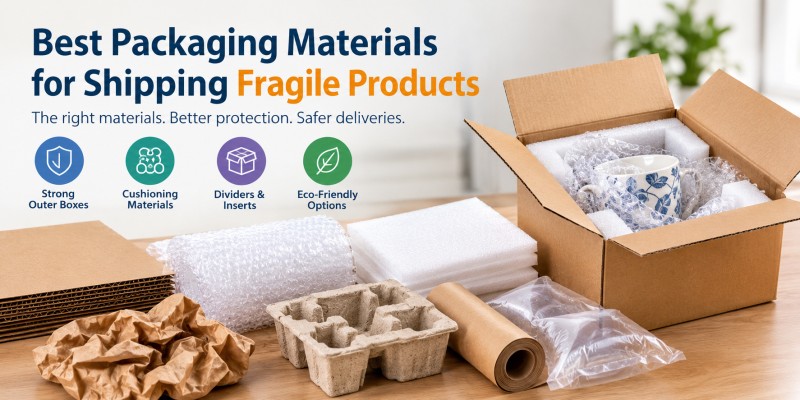
Shipping fragile products requires more than placing an item inside a cardboard box. Glass bottles, ceramic products, electronics, candles, mirrors, and delicate retail goods can crack, scratch, or break when exposed to impact, vibration, compression, and movement during transit. The right packaging materials help absorb shocks, prevent items from shifting, and maintain enough structural support to withstand normal shipping and handling conditions.
The best packaging material depends on the product's weight, shape, fragility, shipping distance, and the way parcels are handled. Bubble wrap may protect lightweight glassware, while foam inserts can hold delicate electronics in position. Corrugated cardboard boxes provide the outer structure, and custom dividers help keep multiple items separated.
This guide explains which packaging materials work best for different fragile products, how to combine them, and what businesses should consider when choosing protective packaging for shipping.
What Are the Best Materials for Shipping Fragile Products?
The most effective packaging system combines a strong outer box with suitable cushioning and internal support. Each material serves a different purpose, so choosing one material to perform every protective function may leave gaps in the packaging.
Here are the most commonly used materials for shipping fragile products.
| Packaging material | Best suited for | Main purpose |
|---|---|---|
| Corrugated cardboard | Most fragile products | Outer structural protection |
| Bubble wrap | Glassware, ceramics, small delicate items | Shock absorption and surface protection |
| Foam inserts | Electronics, instruments, precision products | Fitted cushioning and movement control |
| Molded pulp | Bottles, electronics, and shaped products | Product positioning and cushioning |
| Corrugated dividers | Bottles, jars, and multiple items | Separation and organization |
| Kraft paper | Lightweight products and empty spaces | Void filling and light cushioning |
| Paper cushioning | Retail products and general parcels | Filling gaps and limiting movement |
| Air pillows | Lightweight shipments | Filling larger empty spaces |
These materials are not interchangeable. For example, air pillows can fill space around a packaged product, but they may not provide adequate support for a heavy glass object. Similarly, a strong outer box cannot prevent damage if the item moves freely inside it.
1. Corrugated Cardboard Boxes
Corrugated cardboard is one of the most practical outer packaging materials for shipping fragile products. It consists of paper liners surrounding a fluted paper layer, creating a structure that provides rigidity and helps resist compression.
The appropriate box depends on the product's weight, dimensions, stacking conditions, and shipping environment. A lightweight decorative item may require a different box specification than a heavy glass container or electronic appliance.
Single-Wall vs. Double-Wall Corrugated Boxes
Single-wall corrugated boxes contain one fluted layer between two liners. They are suitable for many lightweight and moderately heavy products when the box strength and internal cushioning match the shipping requirements.
Double-wall corrugated boxes contain two fluted layers separated by liners. They generally provide greater structural support and can be appropriate for heavier products, more demanding handling conditions, or shipments that require additional stacking strength.
However, adding another wall does not automatically make a package safe. Box dimensions, board grade, closure quality, product weight, and cushioning all influence performance.
How to Choose Corrugated Board Strength
When selecting corrugated packaging, consider the following specifications:
- Edge crush test (ECT): Measures the edgewise compressive strength of corrugated board and helps assess its resistance to crushing under specified test conditions.
- Burst strength: Measures the pressure required to rupture the board under a defined test.
- Flute profile: Influences cushioning characteristics, thickness, and structural performance.
- Box dimensions: Affect how the package distributes loads and resists deformation.
For fragile products, choose a box designed for the actual shipping conditions rather than relying on appearance or thickness alone.
2. Bubble Wrap for Shock Absorption
Bubble wrap contains air-filled pockets that help cushion products against impacts. It is widely used for glassware, ceramic ornaments, small appliances, and other items that can be damaged by sudden contact.
The air cells provide a cushioning layer between the product and surrounding packaging. Bubble wrap can also help protect polished or painted surfaces from scratches when applied correctly.
Small Bubbles vs. Large Bubbles
Small-bubble wrap is useful for lightweight products and surface protection. It can fit around smaller objects and irregular shapes without adding excessive bulk.
Large-bubble wrap may provide more cushioning space for larger products, depending on the item and the wrap's construction. However, bubble size alone does not determine protective performance. Product weight, number of layers, material quality, and available cushioning space also matter.
How to Use Bubble Wrap Correctly
Wrap each fragile item separately whenever individual products could collide. Secure the wrapping so it does not loosen during handling, and protect exposed corners or projecting parts where necessary.
Place the wrapped item inside a suitable shipping box with enough cushioning to limit movement. Do not rely on a single thin layer of bubble wrap to protect a heavy or particularly fragile object.
Bubble wrap also has limitations. It can puncture against sharp edges and may compress under substantial loads. Products with these characteristics may require foam, protective sleeves, rigid inserts, or a combination of materials.
3. Foam Inserts for High-Value Products
Foam packaging is useful when a product needs controlled positioning, consistent cushioning, or protection around specific shapes. It is commonly used for electronics, cameras, instruments, precision components, and delicate equipment.
Unlike loose cushioning, a properly designed foam insert can hold an item in a defined position. This reduces the space in which the product can move and helps distribute forces across supported areas.
Common Foam Packaging Types
Polyethylene (PE) foam: Often used for products that need resilient cushioning and surface protection. It is available in different densities and thicknesses.
Polyurethane (PU) foam: Available in flexible forms that can accommodate selected lightweight products and irregular shapes.
Expanded polystyrene (EPS): A rigid, lightweight foam used in molded protective packaging for products requiring shaped support.
The appropriate foam depends on the product's weight, fragility, surface finish, and sensitivity to impact. Electronics may also require electrostatic-discharge protection, which ordinary foam does not necessarily provide.
When Custom Foam Inserts Make Sense
Custom foam inserts are particularly useful for expensive products, repeated shipments, and product kits with several components. The insert can be designed around the item's dimensions, including vulnerable corners, accessories, and protruding parts.
Although custom inserts may require additional design and production costs, they can make packing more consistent and reduce the need for excessive loose cushioning.
4. Molded Pulp Packaging
Molded pulp is made from formed fibrous material and can be shaped to support products in specific positions. It is used for electronics, glass containers, household products, and selected retail packaging applications.
Its primary advantage is that the packaging can be molded around a product's general shape. This helps prevent excessive movement and can reduce the need for separate cushioning components.
Molded pulp is also available in designs using recycled paper fibers, although environmental performance depends on the complete material composition, manufacturing process, coatings, and local recycling facilities.
Is Molded Pulp Suitable for Fragile Items?
Yes, when the molded structure is designed for the product and tested under expected shipping conditions. It can provide useful support around the base, sides, and corners of an item.
However, molded pulp does not automatically protect every product from severe impacts. Its thickness, shape, fit, and resistance to deformation must match the product's weight and fragility.
For businesses shipping glass bottles or electronic devices in volume, molded pulp can be worth evaluating as an alternative to some plastic cushioning systems.
5. Custom Corrugated Dividers and Partitions
When a package contains multiple fragile products, preventing item-to-item contact becomes a major packaging requirement. Corrugated dividers create separate compartments inside a box, helping keep bottles, jars, containers, and other objects apart.
For example, a box carrying twelve glass bottles may use a divider grid that gives each bottle its own compartment. This reduces the likelihood of bottles striking one another when the package is moved.
Fixed and Removable Partitions
Fixed partitions provide a consistent layout for products packed in the same arrangement. They are useful for repeat shipments and standardized production processes.
Removable dividers offer flexibility when the number or arrangement of products changes. They can be useful for mixed-product shipments, provided the dividers remain secure during transportation.
When Are Custom Dividers Necessary?
Consider partition packaging when:
- Several glass bottles or jars share one shipping box.
- Products have hard surfaces that may scratch or break through contact.
- Items must remain in a fixed arrangement.
- Packing teams need a repeatable loading process.
- Different products require separate compartments.
Dividers are not always sufficient by themselves. Fragile products may still require individual wrapping or cushioning inside each compartment, especially when they have delicate finishes or narrow projecting sections.
6. Kraft Paper and Paper-Based Cushioning
Kraft paper and other paper-based cushioning materials can fill empty spaces and reduce product movement. They are commonly used for lightweight products, accessories, and items that do not require highly specialized cushioning.
Crumpled paper can be packed around an item to fill gaps, while paper sheets can separate products or protect selected surfaces.
How Effective Is Paper Cushioning?
Paper cushioning works best when it is packed tightly enough to support the product without placing excessive pressure on it. Loose paper that shifts or settles during transit may leave empty spaces, allowing the item to move.
Paper is not the best standalone choice for every fragile product. Heavy glassware, delicate electronics, and items with sharp edges may need a more controlled cushioning system.
Businesses considering paper-based packaging should test how well the material maintains its shape under compression and repeated handling.
7. Air Pillows for Void Filling
Air pillows are inflatable packaging cushions designed primarily to fill empty spaces within a shipping box. They can help prevent lightweight products from shifting and may reduce the amount of solid cushioning material needed.
They are particularly useful in e-commerce operations where packages contain products of different sizes and packing speed is important.
However, air pillows should not be confused with fitted cushioning. They may move away from the areas that need protection, lose pressure, or become punctured. Heavy items and sharp-edged products can present additional challenges.
Use air pillows when the product and box design allow the cushions to remain in position. For fragile products, combine them with suitable wrapping, dividers, or fitted inserts when necessary.
How to Choose the Right Packaging Material
The right material depends on the specific risks associated with the product. A lightweight ceramic ornament, for example, needs a different packaging arrangement from a heavy glass bottle or a precision electronic device.
Use these factors to guide your selection.
Consider Product Weight
Heavier products place greater loads on the box and cushioning. They may require stronger corrugated board, denser or more supportive inserts, and a design that prevents the item from compressing the cushioning material.
Lightweight products may need less substantial packaging, provided they remain secure and protected against impact.
Evaluate Fragility and Shape
Glass, ceramics, and brittle materials can crack when exposed to concentrated impacts. Products with protruding components may be especially vulnerable at corners, handles, or narrow sections.
Choose materials that support the item's vulnerable areas rather than focusing only on covering its surface.
Account for Shipping Conditions
Packages may experience drops, vibration, compression, and repeated handling. Long-distance shipments and packages moving through automated sorting systems may face different challenges from products delivered locally.
Select packaging based on the likely distribution environment, and test the completed package when damage would be costly.
Balance Protection With Shipping Costs
Oversized boxes require more void fill and may increase dimensional shipping charges. Undersized boxes can compress the cushioning or expose the product to impact.
The goal is not to use the largest box or the most cushioning. It is to use an appropriately sized box and sufficient protective material to keep the product secure throughout transit.
How to Pack Fragile Products for Shipping
Even suitable packaging materials can fail if they are assembled incorrectly. Follow a consistent process to reduce avoidable damage.
Step 1: Inspect the product. Identify fragile areas, sharp edges, detachable components, and surfaces that may scratch.
Step 2: Wrap the product individually. Use bubble wrap, foam, or a suitable protective sleeve. Keep multiple fragile items from touching each other.
Step 3: Prepare the shipping box. Select a structurally sound corrugated box with enough room for cushioning around the item.
Step 4: Add bottom cushioning. Create a protective layer that supports the product and helps prevent direct contact with the box floor.
Step 5: Position the item securely. Use inserts, dividers, or cushioning to maintain its position. Avoid placing fragile products directly against the box walls.
Step 6: Fill empty spaces. Add appropriate void fill so the product cannot shift freely. Avoid overpacking to the point that the box bulges or the product experiences unnecessary pressure.
Step 7: Close and test the package. Seal the box securely and gently check for internal movement. If the contents shift, improve the fit before shipping.
For high-value or especially fragile products, conduct more formal packaging tests appropriate to the product, shipment, and risk level. A simple movement check is useful, but it cannot prove that a package will withstand every transit impact.
Common Packaging Mistakes That Cause Damage
Several preventable mistakes can undermine an otherwise good packaging design.
Using a box that is too large: Excessive space allows the product to build momentum during movement. Properly fitted cushioning or a better-sized box can reduce this risk.
Choosing a weak outer carton: A box that cannot support the product or stacking loads may deform, exposing the contents to damage.
Wrapping several items together: Unprotected contact between glass, ceramics, or other hard products can cause scratches and breakage. Individual wrapping and dividers can help prevent this.
Using loose void fill without checking movement: Materials may settle or shift during transit. Check whether the completed package keeps the item in position.
Ignoring corners and protruding parts: Handles, edges, and projecting components may need dedicated support or additional cushioning.
Assuming a fragile label is enough: Handling labels can communicate instructions, but they do not replace protective packaging.
Skipping package testing: A package that looks secure may still fail under impact or compression. Testing is especially important for recurring commercial shipments and products with high replacement costs.
Are Sustainable Packaging Materials Suitable for Fragile Products?
Businesses can use paper-based cushioning, corrugated inserts, molded pulp, and recycled-content board in many protective packaging applications. These materials may help reduce reliance on some plastic packaging, depending on the design.
However, sustainability should not come at the expense of adequate product protection. A package that allows products to break may create additional waste through replacements, returns, and repeat shipping.
When comparing options, consider recycled content, material weight, recyclability in the destination market, coatings, adhesives, and whether different components can be separated after use.
Paper-based materials are not automatically recyclable in every local system, particularly when contaminated or combined with incompatible coatings. Check local recycling guidance and the actual specifications of the selected packaging.
Custom Packaging Solutions for Fragile Products
Businesses shipping fragile goods regularly may benefit from packaging designed around their product dimensions, packing process, and transportation requirements. Standard boxes can work well for many applications, but unusual shapes, multiple components, and recurring damage problems may call for more tailored solutions.
Custom corrugated boxes provide an outer structure sized for the product. Internal partitions separate multiple items, while fitted inserts help hold individual products in place. Printed packaging can also display branding and handling information without changing the need for appropriate protective construction.
At CustomBoxesZone, businesses can explore custom packaging options based on their product and shipping needs. Before selecting a design, determine the product's weight, dimensions, fragility, order quantity, and expected shipping conditions.
Request a packaging quote with these specifications so the box structure, dividers, and protective inserts can be evaluated for the intended application. For fragile or high-value goods, test the final packaging with the actual product before committing to large-scale shipments.
Final Takeaway
The best packaging materials for shipping fragile products work together to provide structural support, absorb impacts, and prevent movement. Corrugated cardboard protects the shipment from outside forces, while bubble wrap, foam, molded pulp, and dividers address different internal protection needs.
Instead of selecting materials by price or appearance alone, evaluate the product's vulnerabilities and the conditions it will face during transit. A well-matched packaging system can help reduce breakage, improve packing consistency, and make shipping more reliable.