






Corrugated boxes are widely used for shipping, storage, retail packaging, and product protection. However, not all corrugated boxes offer the same level of strength, cushioning, or print quality. One of the main factors that determines how a box performs is its corrugated flute type.
Flutes are the wavy layers of paper sandwiched between flat linerboards. Their height, thickness, and arrangement influence a box's compression strength, cushioning performance, stacking ability, and overall appearance. Selecting the right flute helps businesses protect products during transit while managing packaging costs and meeting their branding requirements.
Whether you need lightweight e-commerce mailers, heavy-duty shipping cartons, or retail-ready packaging, understanding the differences between A, B, C, E, and F flutes can help you make a more informed decision.
This guide explains the main corrugated box flute types, their advantages, common applications, and the factors to consider when choosing the right flute for your packaging needs.
What Are Corrugated Box Flutes?
Corrugated box flutes are the wave-shaped paper layers inside corrugated board. These fluted layers are bonded between flat sheets of paper called linerboards, creating a structure that combines rigidity, cushioning, and strength without requiring a solid, heavy sheet of material.
The curved structure of the fluting helps distribute pressure across the board and provides space that absorbs some impact during handling and transportation. The linerboards form the outer and inner surfaces, helping the board maintain its shape and resist abrasion.
Corrugated board typically consists of three main components:
-
Outer linerboard: The exterior surface that supports printing, branding, and protection against everyday handling.
-
Fluted medium: The wavy paper layer that contributes to cushioning, rigidity, and structural performance.
-
Inner linerboard: The interior surface that supports the fluting and provides a layer between the product and the box structure.
Different flute profiles provide different combinations of thickness, cushioning, compression strength, and printability. The best choice depends on the product's weight, fragility, shipping conditions, and packaging design.
Why Flute Type Matters in Packaging
Choosing the correct flute is about more than selecting a thick or thin cardboard material. It determines how the packaging performs throughout its intended use, from manufacturing and packing to warehouse stacking and final delivery.
Product Protection During Transit
Flute profiles help absorb and distribute some of the forces generated by bumps, vibration, and handling. Larger flutes generally provide more cushioning space, while smaller flutes can provide a more compact and rigid board structure. However, actual protection also depends on the linerboard, board construction, inserts, and packaging design.
Stacking and Compression Strength
Shipping cartons are often stacked on pallets or in warehouses. The corrugated structure helps a box resist vertical loads, but its performance depends on several factors, including flute type, paper strength, box dimensions, humidity, and how the box is assembled.
Printing and Branding Quality
Businesses that require sharp graphics, product information, or branded packaging need to consider the outer surface. Fine flute profiles generally provide a smoother surface for printing than larger flutes, although linerboard quality and printing methods also influence the final result.
Packaging Weight and Storage
Flute thickness affects the internal and external dimensions of a box. A thicker board can provide useful cushioning but may take up more storage space and reduce the usable internal volume for a given external size. A thinner profile can help create compact packaging for lighter products.
Shipping and Material Costs
The most expensive or thickest board is not automatically the best option. Matching the flute to the product can help businesses avoid unnecessary material use while maintaining the required level of protection.
Types of Corrugated Box Flutes
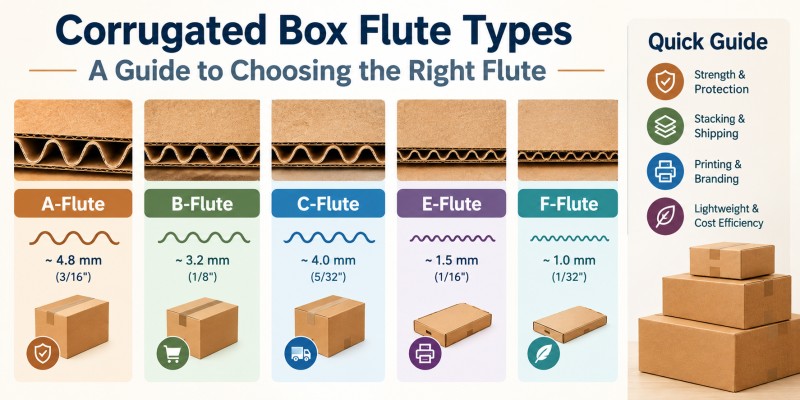
The five commonly discussed flute profiles are A, B, C, E, and F. Each has a different structure and is suited to particular packaging requirements. The measurements below are approximate because actual board thickness and flute counts vary by manufacturer and specification.
|
Flute type |
Approx. board thickness |
Approx. flutes per foot |
Main advantage |
|---|---|---|---|
|
A-flute |
4.5–5.0 mm |
33–36 |
Cushioning and stacking |
|
B-flute |
2.5–3.2 mm |
47–50 |
Crush resistance |
|
C-flute |
3.5–4.0 mm |
38–42 |
Balanced protection |
|
E-flute |
1.0–1.8 mm |
90–95 |
Smooth printing surface |
|
F-flute |
0.6–1.0 mm |
125–130 |
Thin, compact packaging |
These figures are general reference values, not guaranteed manufacturing specifications. Always confirm the board grade and finished thickness with your packaging supplier.
A-Flute: Maximum Cushioning for Fragile Products
A-flute is one of the thickest standard corrugated flute profiles. Its larger arches create a substantial space between the linerboards, helping absorb impacts and supporting the board's resistance to vertical compression.
This construction makes A-flute a useful option when products need additional cushioning during handling, storage, and transportation. It can also provide good stacking performance when combined with suitable linerboard grades and box dimensions.
Common applications include:
-
Glassware and fragile household products
-
Protective shipping cartons
-
Industrial components and equipment
-
Products requiring additional cushioning
-
Outer cartons for carefully packed fragile goods
A-flute is not automatically the strongest option for every shipment. Its larger profile can create a less uniform surface for high-detail printing, and its thickness may increase storage and transportation volume.
When should you choose A-flute?
Consider A-flute when impact protection and cushioning are major priorities. For particularly heavy or fragile items, the complete packaging system should also include suitable inserts, dividers, or protective cushioning materials.
B-Flute: Crush Resistance and Compact Design
B-flute has a shorter, more closely spaced profile than A-flute. This structure creates a relatively compact corrugated board with useful flat-crush and puncture resistance, making it suitable for various retail, industrial, and shipping applications.
Its comparatively thin construction can also work well for die-cut packaging, where accurate folds and defined shapes are important. B-flute provides a practical option for businesses that need a balance between structural performance and efficient use of packaging space.
Common applications include:
-
Canned and packaged food products
-
Die-cut corrugated boxes
-
Retail display packaging
-
Inner cartons and product dividers
-
Packaging for books and household goods
B-flute is particularly useful when the box needs to withstand handling pressure without requiring the thickness of a larger flute. However, its cushioning characteristics differ from those of A-flute and C-flute.
When should you choose B-flute?
Choose B-flute when a compact structure, flat-crush resistance, and die-cutting performance matter more than maximum cushioning. The appropriate linerboard and box design should still be selected according to the product's weight and distribution conditions.
C-Flute: A Versatile Choice for Shipping Boxes
C-flute is widely used in general-purpose corrugated shipping cartons because it offers a practical balance of cushioning, stacking performance, and board thickness. It sits between A-flute and B-flute in approximate profile height.
For many businesses, C-flute provides a suitable starting point for evaluating corrugated packaging. It can accommodate a wide range of everyday products without requiring an unusually thick or thin board construction.
Common applications include:
-
E-commerce shipping boxes
-
General-purpose shipping cartons
-
Household goods packaging
-
Food and beverage outer cartons
-
Consumer product distribution
-
Standard warehouse and fulfillment packaging
C-flute can provide reliable protection for many products, but the finished box's performance depends on more than the flute profile. Paper grade, box dimensions, closure method, moisture exposure, and stacking loads all influence its suitability.
When should you choose C-flute?
Consider C-flute for standard shipping applications where you need a balance of cushioning and structural support. If your products are unusually heavy, fragile, or exposed to demanding transit conditions, evaluate a higher-strength board grade or a double-wall construction.
E-Flute: Better Print Quality for Retail Packaging
E-flute is a microflute profile with a thinner structure and more closely spaced flutes than A, B, or C-flute. Its relatively smooth surface makes it attractive for packaging that needs detailed graphics, product information, and consistent branding.
Because E-flute is thinner, it can also help reduce the space occupied by packaging. Its compact structure works well for smaller products and designs where presentation is almost as important as protection.
Common applications include:
-
Custom printed retail boxes
-
Cosmetic and skincare packaging
-
Lightweight e-commerce mailers
-
Electronics accessory boxes
-
Bakery and specialty food packaging
-
Point-of-sale displays
E-flute is often chosen when businesses want the structural benefits of corrugated board without the bulk of a traditional shipping carton. However, it generally provides less cushioning than larger flute profiles, so fragile or heavy products may need additional internal protection.
When should you choose E-flute?
Choose E-flute when printing quality, a compact profile, and a professional retail appearance are key requirements. It is particularly suitable for lightweight products that need a printed outer package rather than a heavy-duty transport carton.
F-Flute: Thin Packaging for Premium Presentation
F-flute is a very fine microflute profile designed for applications where a slim board structure and detailed printed graphics are important. Its small flute height can create a packaging surface that looks closer to traditional folding carton board while retaining the structural features of corrugated material.
F-flute can be useful for compact products, premium retail packaging, and applications where excessive box thickness would detract from the presentation.
Common applications include:
-
Small gift boxes
-
Jewelry and accessory packaging
-
Premium retail cartons
-
Compact consumer product packaging
-
Printed packaging for lightweight items
Its thin profile can help create crisp folds and a neat appearance. However, F-flute should not be selected solely because it looks more refined. Product weight, handling conditions, stacking requirements, and the need for internal cushioning must also be considered.
When should you choose F-flute?
Consider F-flute for lightweight products that require compact dimensions and detailed printing. For products exposed to substantial impact or heavy stacking loads, a larger flute or a reinforced construction may be more appropriate.
Single-Wall vs. Double-Wall Corrugated Board
The number of fluted layers is another important consideration when choosing corrugated packaging. A single-wall board contains one fluted medium between two linerboards, while double-wall board combines two fluted layers with three linerboards.
Triple-wall board uses three fluted layers separated by four linerboards, creating a heavier-duty structure for demanding applications.
Single-wall corrugated board
Contains one fluted layer and two linerboards. It is commonly used for everyday shipping cartons, retail packaging, and lightweight to moderately demanding distribution needs.
Double-wall corrugated board
Combines two fluted layers and three linerboards. It can provide increased rigidity and load-bearing performance for heavier products, export shipments, and demanding distribution conditions.
Triple-wall corrugated board
Uses three fluted layers and four linerboards. It is used for selected heavy industrial products, bulk shipments, and applications that require a substantial corrugated structure.
What Are BC and EB Flute Combinations?
Double-wall corrugated board can combine two different flute profiles to balance structural performance and print quality.
-
BC flute: Combines B-flute and C-flute layers. It is a common choice for demanding shipping applications that need additional protection and rigidity.
-
EB flute: Combines E-flute and B-flute layers. It can provide a relatively smooth outer surface for printed graphics alongside a second layer of structural support.
The precise performance of either combination depends on the linerboard grades, flute arrangement, adhesive, and finished board specification.
Which construction should you choose?
Single-wall board is often sufficient for everyday packaging. Double-wall board may be appropriate when products are heavier, cartons are stacked under greater loads, or shipments face more demanding handling conditions. Triple-wall board is generally reserved for specialized heavy-duty applications.
The goal is to specify enough protection for the shipment without adding unnecessary material or weight.
How to Choose the Right Corrugated Box Flute
Selecting the right flute requires evaluating the product, packaging design, shipping environment, and presentation requirements together. A flute that works well for a lightweight retail product may not provide enough protection for a heavy shipment.
Use the following factors to narrow down your options.
Consider Product Weight and Dimensions
Start by identifying the product's weight, size, and shape. Lightweight items may work well with E-flute or F-flute, while standard shipping cartons often use C-flute. Heavier products may require a stronger single-wall grade or double-wall construction.
Box dimensions also matter. Large cartons can be more susceptible to bending and compression, so their board specification should account for the size and distribution of the load.
Evaluate Fragility and Cushioning Needs
Glass, ceramics, electronics, and other fragile items need protection against impacts and vibration. A larger flute may provide additional cushioning, but the product should also be secured inside the box.
For example, a glass product shipped in an A-flute carton may still break if it moves freely inside the packaging. Properly fitted inserts, dividers, and cushioning materials help reduce movement and distribute impact forces.
Determine Stacking Requirements
If boxes will be stacked in a warehouse, on pallets, or inside a delivery vehicle, compression performance becomes an important consideration.
Ask your supplier about the box's compression requirements and the appropriate board grade. Edge crush test (ECT) ratings and box compression testing can help assess whether a particular construction suits the expected load.
Match the Flute to Your Printing Requirements
Businesses selling products through retail stores or online channels often need packaging that represents their brand accurately. Smaller flute profiles, particularly E-flute and F-flute, can offer a smoother surface for printed graphics.
However, flute type is only one part of print quality. Linerboard selection, printing technology, coatings, and the quality of the artwork also influence the final result.
Account for Storage and Transportation
Packaging thickness affects warehouse storage, pallet configuration, and transportation efficiency. A larger flute may provide useful cushioning, but it can also increase the external dimensions of a carton.
If you ship products in high volumes, compare the protective performance of different board constructions against their storage and freight implications.
Request Samples Before Ordering
When possible, request samples or prototypes before placing a large production order. A sample allows you to evaluate the board's stiffness, print quality, folding performance, and suitability for your product.
For products shipped over long distances or exposed to demanding conditions, consider transit testing with the actual product and intended packaging configuration.
Common Applications for Different Flute Types
The following examples provide a practical starting point for matching flute types to packaging applications.
|
Packaging application |
Flute to consider |
Main consideration |
|---|---|---|
|
Standard shipping cartons |
C-flute |
Balanced protection |
|
Fragile glass products |
A-flute or suitable double-wall board |
Cushioning and inserts |
|
Retail display packaging |
B-flute or E-flute |
Structure and appearance |
|
Lightweight printed mailers |
E-flute |
Compact design and graphics |
|
Small premium retail cartons |
F-flute |
Thin profile and presentation |
|
Heavy industrial shipments |
Suitable double-wall or triple-wall board |
Load and transit conditions |
|
Canned products |
B-flute or an application-specific grade |
Crush resistance and carton design |
These are general recommendations, not universal specifications. The correct choice depends on the actual product, box dimensions, distribution environment, and required performance.
Common Mistakes When Selecting Corrugated Flutes
Choosing a flute based only on its thickness can lead to unnecessary costs or inadequate product protection. Avoid these common mistakes when specifying corrugated packaging.
Assuming thicker always means better: A larger flute may provide more cushioning, but it may not be the most efficient option for compact retail packaging or high-detail printing.
Ignoring the board grade: Two boxes made with the same flute profile can perform differently because of variations in linerboard strength, paper weight, and construction quality.
Overlooking humidity: Corrugated board can lose strength when exposed to moisture. Products stored in humid warehouses or shipped through challenging climates may need an appropriate material specification and additional protection.
Choosing a flute without testing the box: The finished box's dimensions, joints, closures, and load distribution affect its performance. Testing the complete package provides more useful information than evaluating the flute alone.
Using excessive packaging: Selecting a heavy-duty board for every product can increase material consumption and transportation costs. Match the construction to the actual protection requirements.