




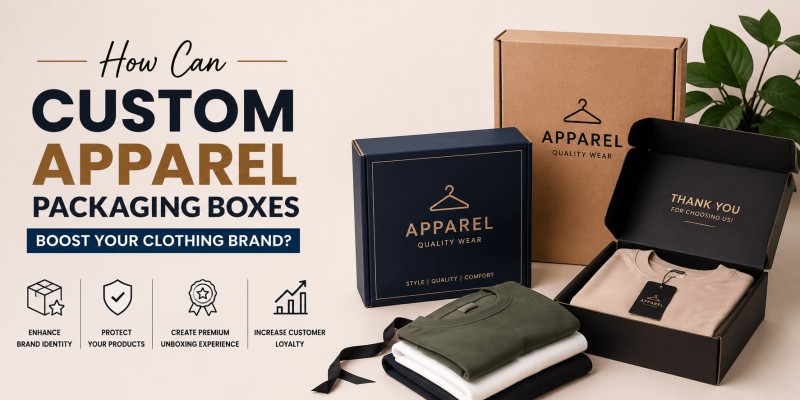
In the fashion and apparel world, making a great product is only half the job. If that product doesn't reach the customer in packaging that looks and feels as good as it does, the brand impression falls short. That's exactly why boutiques and large-scale online fashion stores alike are investing heavily in custom apparel packaging boxes today. It's not just a box; it's the first physical handshake between your brand and your customer.
If you're searching for custom clothing packaging that's sturdy, attractive, and budget-friendly, this guide covers everything: the box types and formats available, how to match packaging to your brand segment, sizing, materials, printing, the unboxing extras that drive social shares, 2026 trends, and why ordering wholesale makes sense for growing brands.
Quick answer: Custom apparel packaging boxes are branded boxes built to protect garments and elevate the unboxing experience. The most popular formats are kraft folding boxes, rigid clothing boxes, corrugated mailers, and mailing tubes. Minimum orders start at just 50 boxes, with 7–8 business-day production, full-color printing, Pantone matching, and free design support.
What Is Custom Clothing Packaging?
Custom clothing packaging refers to specially designed boxes, mailers, and bags used to store, ship, and display apparel. Whether it's a simple kraft tuck box or a premium magnetic-closure rigid box, the goal stays the same: protect the garment and turn the unboxing moment into something memorable. You can explore the full range on our apparel packaging collection.
When a customer receives a parcel wrapped in clean, well-branded, professionally finished packaging, they're not just buying a product; they're buying an experience. And in fashion, that experience is often what drives the repeat purchase — and the unboxing photo that markets your brand for free.
Why Packaging Matters So Much for Fashion Brands
Packaging isn't just about protection anymore. It's a branding tool, a marketing asset, and a trust-builder rolled into one.
First impression: The moment a box is opened, the customer forms an opinion about the brand — before they feel the fabric or check the fit.
Brand recall: Well-branded packaging sticks in memory and routinely gets shared on social media during unboxing.
Protection: Silk scarves, embroidered fabrics, and designer apparel need shielding from creasing, moisture, and dust.
Professional appeal: Thoughtful packaging can make even a small boutique look like an established brand.
There's a business case underneath all of this. Better garment presentation reduces the "this looks cheaper than expected" returns, a positive unboxing lifts repeat-purchase rates, and right-sized boxes cut dimensional-weight shipping costs. Packaging is one of the few investments that improves brand perception and unit economics at the same time.
Apparel Packaging Respects How Fabric Behaves
A box designed for cosmetics or hardware rarely works for apparel without changes, because fabric behaves differently from rigid goods. Clothing creases when it's compressed, absorbs moisture in transit, and loses shape if the box is the wrong size. Good custom clothing boxes account for that — enough room to keep garments folded without hard creasing, a moisture-aware material for humid routes or swimwear, and a structure that holds its shape under stacking. Matching the packaging to the garment is what separates apparel packaging from a generic box with a logo on it.
Match the Packaging to Your Brand Segment
Fashion is not one-size-fits-all, and neither is apparel packaging. Each segment has different expectations:
Luxury and premium rigid boxes with magnetic or lift-off lids, foil stamping, embossing, and soft-touch lamination. The weight and structure signal that the product inside is worth its price.
Streetwear and casual printed folding cartons or branded mailers in bold color; cost-efficient at volume while still photographing well for drops.
Activewear and everyday durable corrugated mailers that survive courier handling, with a clean printed interior for the unboxing.
Delicates, lingerie, and silk soft-touch or padded boxes with inserts and tissue that protect fine fabric and add a gifting feel.
Sustainable and eco brands recycled kraft, biodegradable stock, soy inks, and zero-plastic inserts that back up the brand's values.
Choosing the segment first makes every later decision material, format, finish far easier.
Box Types and Formats We Manufacture
We offer more than 65 variations of clothing packaging. Here are the most popular, grouped by what they do:
Custom kraft apparel boxes a natural, rustic, eco-friendly look that keeps clothes neatly folded and prints cleanly with your logo.
Custom shirt boxes structured boxes that keep folded shirts crisp and wrinkle-free, ideal for retail display and gifting.
Custom blouse boxes built for delicate, fitted garments, keeping fabric wrinkle-free.
Custom tights and socks boxes compact, display-friendly boxes for smaller items, great for shelves and shipping.
Custom scarf boxes often gifted, so available from standard cardboard up to rigid finishes.
Custom swimwear boxes moisture-resistant material with stylish printing for summer brands.
Custom silk stocking boxes extra padding and soft-touch finishing for a luxury feel.
Tie pin, bow tie, and accessory boxes precisely sized boxes with inserts to hold small accessories securely.
Custom shawl boxes sturdier board for larger, heavier fabric items.
Choosing a Format: Folding Box vs Rigid vs Mailer vs Tube
Beyond the specific product, the format decides cost and impression. Here's how the four main options compare:
| Format | Best for | Impression | Relative cost |
|---|---|---|---|
| Folding carton (tuck / lid) | Retail shelf, gifting, most apparel | Clean, professional | Low–mid |
| Rigid box (magnetic / lift-off) | Luxury, high-ticket, gifts | Premium, weighty | High |
| Corrugated mailer | E-commerce, direct-to-customer shipping | Sturdy, branded unboxing | Mid |
| Mailing tube | Lightweight, rolled, or novelty apparel | Distinctive, memorable | Mid |
Most growing brands run a folding carton or branded mailer for the core range and a rigid box for premium or gift SKUs balancing cost against the impression each product needs to make.
Sizes, Dimensions, and Minimum Order Quantities
Every brand's product is different, so we don't use fixed sizing all sizes and shapes are fully customizable to your exact length, width, and height, from a small tie-pin box to a large shawl box. Right-sizing matters twice: it keeps garments from shifting, and it cuts dimensional-weight shipping cost on every order.
Minimum order quantities stay flexible:
| Packaging type | Minimum order | Notes |
|---|---|---|
| Apparel boxes | 50 pieces | Accessible for startups and boutiques |
| Mylar garment bags | 1,000 bags | 500 per design |
| Wholesale runs | 500–10,000+ | Lower per-unit cost as volume rises |
A 50-box minimum makes it easy for startups and small boutiques to launch or test a design without committing to a large upfront run.
Material Options for Every Fabric Type
Durability comes down to the material:
Kraft paper eco-friendly, natural, cost-effective; see our brown kraft stock.
E-flute corrugated added strength for shipping protection.
Bux board medium-weight, sturdy structure.
Cardstock (10pt–28pt / 60lb–400lb) from light to heavy-duty.
Rigid board the premium, luxury-feel option for high-end labels.
Rigid board is best for a luxury feel, kraft is the go-to for sustainable, budget-friendly clothing packaging, and corrugated is the safe choice whenever a garment ships direct to the customer.
Printing and Finishing Options to Elevate Your Brand
For printing: no-print plain packaging, CMYK full-color, CMYK + 1 PMS, and CMYK + 2 PMS, with Pantone matching for brand-critical color.
For finishing: gloss, matte, and soft-touch lamination; gloss AQ / gloss UV; matte UV; spot UV; embossing; and foiling in gold, silver, and custom colors. These finishes give your apparel boxes a premium, retail-ready look whether you are a luxury label or a casual streetwear brand.
The Unboxing Ecosystem: Small Extras, Big Impression
The box gets the attention, but the details create the moment customers photograph and share. Branded tissue paper, custom stickers and seals, printed thank-you cards, ribbon ties, kraft tape, and protective inserts all turn a shipment into an experience. These extras cost little per order yet do a disproportionate amount of the brand-building they are the difference between "my order arrived" and a post on social media. Even a single accent color across tissue, tape, and card reads as a considered, premium brand.
Structural and Style Options
Every brand's needs differ, so multiple structural options are available: die cutting, gluing, scoring, perforation, window cut-outs for display, magnetic closures and drawer-style rigid boxes, and ribbon ties and inserts. These help you build custom clothing packaging that's both functional and visually striking.
Common Packaging Mistakes to Avoid
Wrong material for the product weight: Lightweight cardstock won't protect a heavier item like a shawl or jacket in transit.
Overdesigning at the cost of function: Foiling and multiple PMS colors look great, but if the box doesn't close securely or fit the garment, the flaw is noticed before the finish.
Ignoring shipping conditions: A shelf-perfect box may not survive a courier journey without corrugated support.
Inconsistent branding across SKUs: Mismatched packaging styles weaken brand recognition over time.
Skipping a physical sample: Approving only from a flat or 3D mockup risks surprises in production — a physical sample avoids costly reprints.
Packaging Trends Shaping Clothing Brands in 2026
- Minimalist branding with a single accent color is replacing heavily printed designs for a cleaner, more premium feel.
- Reusable, multipurpose packaging customers can repurpose is gaining traction as sustainability drives purchases.
- Matte and soft-touch finishes continue to outperform gloss for apparel, giving a tactile, high-end impression.
- QR codes and NFC tags connect customers to care instructions, styling videos, or loyalty programs.
- Size-specific packaging is replacing one-size-fits-all boxes with SKU-matched dimensions that cut waste and shipping cost.
- Staying aligned with these shifts keeps a clothing brand's packaging feeling current without a full redesign every season.
How to Choose the Right Apparel Packaging
Choosing the right packaging comes down to four questions:
- What's the product? Delicate silk needs soft, padded boxes; heavier pieces like shawls or jackets need stronger corrugated board.
- What's your brand's tone? Luxury positioning favors rigid boxes with foiling and embossing; casual or budget brands do well with kraft and simple CMYK.
- How will it ship? Direct-to-customer courier orders need extra-protective corrugated packaging.
- What's your budget? More finishing means higher cost, so set your budget first, then choose materials and printing.
Once you've answered these, designing the right clothing packaging becomes far easier and our team guides you through the entire process.
Sustainable and Eco-Friendly Packaging
Today's customers look at how responsibly a brand operates. To match that, we offer recycled kraft boards, biodegradable materials, soy-based inks, and zero-plastic inserts. If your audience values sustainability, eco-friendly clothing packaging strengthens your reputation without compromising the premium feel and it's worth stating your material choices right on the box or insert, since customers reward the transparency.
Benefits of Ordering Apparel Boxes Wholesale
Lower per-unit cost: Bulk orders significantly reduce pricing as volume rises.
Consistent branding: Every order matches in quality and design.
Fast turnaround: Production completes in 7–8 business days.
Batch printing: Different SKUs or seasonal designs can run in a single order.
If you're launching multiple products or seasonal collections, wholesale ordering also takes the stress out of inventory management.
Searching for "Clothing Packaging Near Me"? You Don't Have To
If you've been searching for a local packaging supplier, you don't need to anymore. We ship fast across the entire USA New York, Los Angeles, Austin, and everywhere in between. Whether you run a local boutique or a national online store, we deliver every order on time, nationwide, with free design support on every order.
Final Thoughts
Custom apparel packaging boxes aren't just a necessity; they're part of your brand's growth strategy. By matching the right segment, format, material, and finish to your product, you give customers more than a well-packed item you give them a complete brand experience that drives repeat purchases and free social exposure.
Ready to design the perfect packaging for your clothing line? Request a free quote today and give your brand a look customers won't forget.