






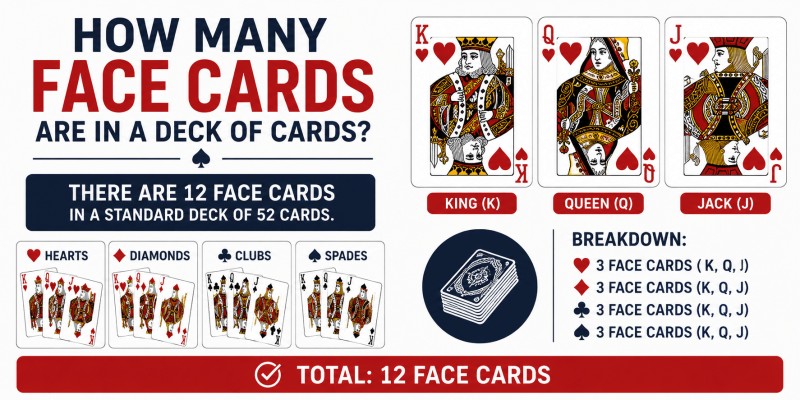
If you have ever sat down for a card game and wondered, how many face cards are in a deck? You are not alone. This is one of the most common questions asked by card game beginners and curious minds alike. Whether you are playing poker, blackjack, or just shuffling through a standard deck, understanding the structure of a deck of playing cards is essential knowledge.
In this complete guide, we will walk you through everything you need to know about face cards: what they are, how many there are, why they matter, and even how custom card packaging plays a role in protecting and presenting these iconic cards.
What Are Face Cards?
Face cards are the cards in a standard deck that feature illustrated human figures rather than simple number pip symbols. These are the cards that carry royal imagery, making them instantly recognizable and culturally significant across the world.
In a standard 52-card deck, the face cards are:
- King (K)
- Queen (Q)
- Jack (J)
These three ranks appear across all four suits, Hearts, Diamonds, Clubs, and Spades, giving you a total of 12 face cards in a standard deck of 52 playing cards.
How Many Face Cards Are in a Deck?
The direct answer is there are 12 face cards in a standard 52-card deck.
Here is how it breaks down:
| Face Card | Hearts | Diamonds | Clubs | Spades | Total |
|---|---|---|---|---|---|
| King | 1 | 1 | 1 | 1 | 4 |
| Queen | 1 | 1 | 1 | 1 | 4 |
| Jack | 1 | 1 | 1 | 1 | 4 |
| Total | 12 |
So out of 52 cards, 12 are face cards, and the remaining 40 are numbered cards (Ace through 10 across four suits).
Are Aces Considered Face Cards?
This is a question that confuses many people. No, Aces are not face cards. An ace is a pip card; it shows a single symbol (pip) of its suit rather than a royal figure. However, the Ace is often considered the most powerful card in many games, ranking above the King in games like poker.
So to be clear:
- Face cards = King, Queen, Jack only
- Ace = pip card, not a face card
What About Jokers?
A standard deck often comes with 2 Joker cards, but they are not part of the official 52-card deck. Most classic card games do not use jokers. When Jokers are included, the deck becomes a 54-card deck. Jokers also feature illustrated figures, but they are not classified as face cards in the traditional sense.
The History Behind Face Cards
Face cards have a rich history dating back to 14th-century France and Germany. The earliest playing cards were hand-painted and extremely valuable. Over time, the French four-suit system, Hearts, Diamonds, Clubs, and Spades, became the global standard.
Each face card traditionally represented a historical or mythological figure:
- King of Hearts: Charlemagne
- King of Diamonds: Julius Caesar
- King of Clubs: Alexander the Great
- King of Spades: King David
- Queen of Hearts: Judith
- Queen of Diamonds: Rachel
- Queen of Clubs: Argine
- Queen of Spades: Pallas Athena
- Jack of Hearts: La Hire
- Jack of Diamonds: Hector
- Jack of Clubs: Lancelot
- Jack of Spades: Ogier the Dane
These associations vary by country and card manufacturer, but the historical depth behind face cards adds a layer of meaning that numbers simply cannot match.
Why Do Face Cards Matter in Card Games?
In many popular card games, face cards carry special value or significance:
Blackjack
In blackjack, all face cards (king, queen, and jack) have a value of 10 points. This makes them highly desirable because, when paired with an Ace, they create a "blackjack," the best possible hand.
Poker
In poker, face cards contribute to high-value hands. A hand with kings or aces is generally strong, and face cards play into straights, flushes, and full houses.
Rummy
In rummy-style games, Kings, Queens, and Jacks typically carry 10 points each and are considered high-value cards. Players often race to use them in melds before being caught with them in hand.
Go Fish and War
Even in simple games, face cards often rank above number cards, making them powerful assets in a player's hand.
How Many Red Face Cards Are in a Deck?
Since there are two red suits, Hearts and Diamonds, you will find the following:
- 6 red face cards (King, Queen, and Jack of Hearts + King, Queen, and Jack of Diamonds)
- 6 black face cards (King, Queen, and Jack of Clubs + King, Queen, and Jack of Spades)
This is useful knowledge for card tricks, probability problems, and certain game rules.
Probability: What Are the Chances of Drawing a Face Card?
With 12 face cards out of 52 total cards, your probability of drawing a face card at random is:
12 ÷ 52 = 0.2308, or approximately 23.08%
That means roughly 1 in every 4.3 cards you draw is likely to be a face card. This statistic is commonly used in card game strategy and mathematical probability lessons.
Custom Playing Card Packaging: Why It Matters
Now that you understand the structure of a deck of cards, let us talk about something equally important: the packaging that protects and presents these cards.
Whether you are a card game manufacturer, a magician, a game designer, or a retailer, the way your deck is packaged speaks volumes about the quality and value inside.
At Custom Boxes Zone, we specialize in creating premium custom card packaging that:
- Protects your cards from moisture, dust, and physical damage
- Showcases your brand with vibrant, full-color printing
- Creates an unforgettable unboxing experience for customers
- Supports custom sizes for standard decks, tarot cards, oracle cards, and more
From tuck boxes to rigid lid boxes, sleeve boxes to display packaging, we offer custom solutions tailored to your exact needs. Great cards deserve great packaging, and we make sure your deck makes the perfect first impression.
Types of Card Box Packaging We Offer
Tuck-end boxes
The most classic card box style. A tuck-end box is compact, easy to open, and perfect for standard 52-card decks. Fully customizable with your logo, design, and finish.
Rigid Card Boxes
For premium or collector decks, a rigid box adds a luxurious feel. These are ideal for gift sets, limited edition releases, and high-end game products.
Sleeve and Tray Boxes
A sophisticated two-piece design where a sleeve slides over a tray. Popular for upscale card games and tarot card sets.
Window Cut-Out Boxes
Allow customers to see the cards inside without opening the box. Great for retail displays and gift packaging.
What Makes a Great Card Box?
When choosing packaging for a card deck, keep these factors in mind:
- Material: Use sturdy cardboard or kraft material for durability
- Print quality: High-resolution printing ensures your design looks sharp and professional
- Finish: Matte, gloss, UV spot, or foil stamping can elevate the look and feel
- Sizing: The box should fit your deck snugly, not too tight, not too loose
- Eco-friendliness: Recyclable and sustainable materials are increasingly important to customers
At Custom Boxes Zone, we handle all of these factors and work closely with you to create packaging that perfectly fits your product and brand identity.
Fun Facts About Playing Cards
- A standard deck has 52 cards representing the 52 weeks of the year
- The 4 suits represent the 4 seasons
- The 13 cards per suit represent the 13 lunar cycles in a year
- The total value of all cards in a deck adds up to 365, one for each day of the year (counting Ace as 1, Jack as 11, Queen as 12, King as 13)
- The red and black split represents day and night
Playing cards are more than just a game; they are a reflection of time, history, and human culture.
Conclusion
So, to answer the original question clearly: there are 12 face cards in a standard deck of 52 playing cards. These are the king, queen, and jack of each of the four suits: hearts, diamonds, clubs, and spades.
Face cards are more than just high-value game pieces. They carry centuries of history, cultural meaning, and visual beauty that makes a deck of cards truly special.
And when your cards deserve the best, Custom Boxes Zone is here to provide packaging that matches that standard. Whether you need custom tuck boxes, luxury rigid packaging, or eco-friendly card boxes, we have got you covered.
Ready to package your cards in style? Visit customboxeszone.com today and get a free custom quote for your card packaging needs.