




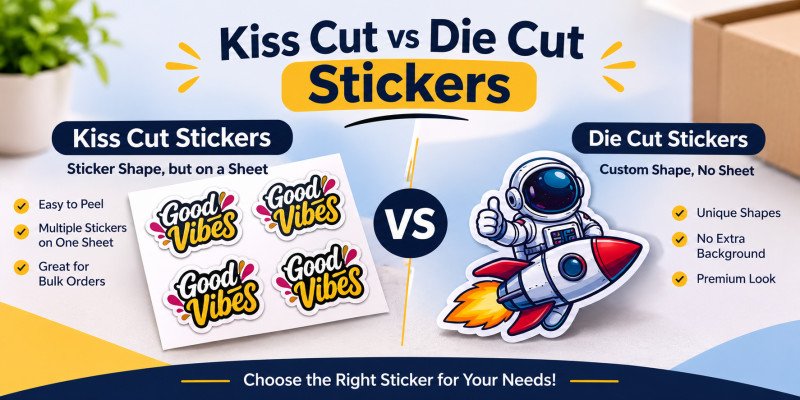
Both sticker types can feature customized shapes, colors, graphics, and designs, their cutting methods make them different. Kiss-cut stickers have cuts through the sticker material while leaving the backing sheet intact. In contrast, die-cut stickers are cut through both the sticker material and its backing, creating individually separated pieces.
Understanding the difference between kiss-cut vs. die-cut stickers can help you choose the right option for your packaging and branding requirements. Let's explore their features, materials, applications, and benefits to determine which one works best for your business.
What Are Kiss-Cut Stickers?
Kiss-cut stickers are custom stickers cut through their printed surface and adhesive layer without cutting through the backing paper. This means the sticker remains attached to a larger backing sheet until someone peels it off.
The extra backing material creates a protective border around the sticker design. It also makes these stickers easier to handle, store, and distribute.
For example, if you order custom logo stickers for your packaging boxes, kiss-cut stickers allow you to keep multiple designs on a single backing sheet. You can easily remove individual stickers whenever required.
Key Features of Kiss-Cut Stickers
- Easy Peeling: The extra backing makes stickers easier to remove without damaging delicate designs.
- Protective Borders: The surrounding backing protects intricate sticker edges during handling.
- Multiple Designs: Several sticker designs can be arranged on one sheet.
- Custom Printing: You can add brand logos, product information, illustrations, and promotional messages.
- Convenient Storage: The flat backing makes these stickers easy to organize and distribute.
Where Are Kiss-Cut Stickers Used?
Kiss-cut stickers are widely used in packaging, retail, marketing, and promotional applications.
Some common uses include:
- Custom product packaging labels.
- Logo stickers for packaging boxes.
- Promotional sticker sheets.
- Thank-you stickers for shipping boxes.
- Decorative stickers for gift packaging.
- Product identification and branding.
- Stickers for subscription box inserts.
Their easy-peel design makes them particularly useful for businesses that need to apply multiple stickers during packaging and order fulfillment.
What Are Die-Cut Stickers?
Die-cut stickers are individually cut through both the sticker material and the backing paper. The cutting follows the shape of your artwork, creating a finished sticker that matches your chosen design.
Unlike kiss-cut stickers, die-cut stickers do not retain a larger shared backing sheet around the design. Each sticker becomes a separate piece.
For instance, if you want to showcase your company logo on promotional packaging, die-cut stickers can follow the exact outline of your logo. This creates a clean and professional appearance that helps your brand stand out.
Key Features of Die-Cut Stickers
- Custom Shapes: Stickers can be cut according to your artwork and design outlines.
- Individual Pieces: Each sticker is completely separated from the surrounding material.
- Professional Appearance: The backing follows the sticker's custom shape.
- Branding Opportunities: You can print logos, graphics, illustrations, and promotional artwork.
- Versatile Applications: They are suitable for packaging, merchandise, giveaways, and product branding.
Where Are Die-Cut Stickers Used?
Die-cut stickers are a popular choice for businesses looking to create distinctive branding materials.
Common applications include:
- Custom logo stickers.
- Product packaging seals.
- Promotional giveaways.
- Retail merchandise stickers.
- Custom stickers for gift boxes.
- Laptop and decorative stickers.
- Branded shipping box stickers.
Their individual presentation makes them suitable for businesses that distribute stickers separately or use them as promotional merchandise.
Kiss-Cut vs. Die-Cut Stickers: Key Differences
Both sticker types offer excellent customization opportunities. However, their cutting methods, backing structures, and applications are different.
Here is a quick comparison to help you understand their differences:
| Features | Kiss-Cut Stickers | Die-Cut Stickers |
|---|---|---|
| Cutting method | Cuts sticker material only | Cuts sticker and backing |
| Backing | Remains intact | Cut to sticker shape |
| Presentation | Sticker on a larger backing | Individually shaped piece |
| Peeling | Generally easier | May require more care |
| Design options | Custom shapes | Custom shapes |
| Sticker sheets | Excellent choice | Not typically supplied as shared sheets |
| Storage | Convenient on sheets | Stored as individual pieces |
| Best application | Packaging labels and sticker sheets | Individual branding stickers and giveaways |
The main difference: Kiss-cut stickers retain their original backing sheet, whereas die-cut stickers are cut completely through the backing to create separate pieces.
Remember that both types can use the same printing materials, adhesives, and finishes. The primary difference is their cutting depth and final presentation.
Which Sticker Materials Are Best for Kiss-Cut and Die-Cut Stickers?
The material you select plays an important role in sticker durability, appearance, and application. Both kiss-cut and die-cut stickers can be manufactured using different materials according to your packaging requirements.
Here are some commonly used options:
1. Vinyl
Vinyl is a popular sticker material because of its flexibility, durability, and smooth printing surface. It is suitable for custom branding stickers, product labels, and promotional applications.
Vinyl stickers can also be paired with protective laminations to improve resistance to moisture, scratches, and everyday handling.
2. Paper
Paper stickers are an economical option for indoor applications and everyday packaging requirements. They are suitable for product labels, gift packaging, thank-you stickers, and promotional inserts.
You can customize them with different printing designs and finishes to complement your packaging boxes.
3. BOPP
Biaxially oriented polypropylene (BOPP) is commonly used for product labels because of its strength and moisture resistance. It is particularly useful for packaging applications involving cosmetics, beverages, food containers, and personal care products.
4. Clear Plastic Film
Clear sticker materials create a transparent appearance that allows the underlying packaging surface to remain visible. They are suitable for minimalist product branding and premium packaging designs.
Choosing the right material depends on your application, packaging surface, environmental conditions, and desired appearance.
How Do Kiss-Cut and Die-Cut Stickers Improve Product Packaging?
Packaging plays an important role in creating a positive impression of your products. Custom stickers provide businesses with an affordable way to enhance their packaging without redesigning the entire box or container.
Both sticker types offer several branding and packaging benefits.
1. Improve Brand Recognition
Custom stickers allow you to display your company logo, brand colors, and promotional messages. You can apply them to custom cardboard boxes, mailer boxes, retail packaging, and gift boxes.
Consistent branding helps customers recognize your business and creates a more professional packaging experience.
2. Create Attractive Packaging
Plain packaging can sometimes look less distinctive on retail shelves. Adding custom stickers can instantly improve its appearance.
For example, die-cut logo stickers can create a distinctive visual effect on rigid gift boxes, while kiss-cut stickers can provide multiple decorative designs for subscription box packaging.
3. Secure Packaging Closures
Stickers can also be used as box closure seals. Businesses often apply them to the opening flaps of mailer boxes, folding cartons, and gift packaging.
However, ordinary stickers should not be considered tamper-evident security seals unless they are specifically designed and tested for that purpose.
4. Support Promotional Campaigns
Kiss-cut sticker sheets and individual die-cut stickers are useful for promotional giveaways, product launches, seasonal campaigns, and customer appreciation packages.
You can include them inside shipping boxes to encourage customer engagement and increase brand visibility.
5. Provide Cost-Effective Branding
Instead of investing in fully printed packaging for every campaign, businesses can use customized stickers to update their existing packaging.
This approach is particularly useful for small businesses that want flexible branding options without changing their entire packaging inventory.
Kiss-Cut vs. Die-Cut Stickers: Which One Is Better for Packaging?
The best choice depends on how you intend to use your stickers.
Choose kiss-cut stickers if:
- You need multiple stickers on one sheet.
- You want easy peeling and handling.
- You have intricate or delicate sticker designs.
- You need stickers for subscription boxes.
- You want to distribute promotional sticker sheets.
- You need convenient stickers for repeated packaging applications.
Choose die-cut stickers if:
- You want individually separated stickers.
- Your brand requires distinctive logo shapes.
- You need individual promotional giveaways.
- You want custom-shaped stickers for gift boxes.
- You prefer a finished, standalone sticker presentation.
For example, a bakery can use kiss-cut stickers to organize different product labels on a single sheet. Meanwhile, a cosmetic brand can use individually die-cut logo stickers for promotional packaging and branded merchandise.
Neither option is universally better. Your packaging process, design requirements, and distribution method should determine your final choice.
How to Choose the Right Custom Stickers for Your Business?
Before ordering custom stickers, consider a few important factors to ensure you select the right option.
1. Understand Your Application
Determine whether you need stickers for product labeling, box sealing, promotional giveaways, or decorative purposes. Your intended application will help you select the appropriate cutting style.
2. Select the Right Material
Consider the packaging surface and environmental conditions. Paper, vinyl, BOPP, and clear films offer different performance characteristics.
3. Choose Suitable Dimensions
Your sticker size should complement your packaging dimensions. Small logo stickers work well on compact product boxes, while larger designs may be suitable for shipping cartons and promotional packaging.
4. Consider Your Artwork
Complex logos and detailed illustrations can benefit from the protective border of kiss-cut stickers. Die-cut stickers are a good choice when you want individual pieces that follow your artwork's outline.
5. Select the Appropriate Adhesive
Different packaging surfaces require different adhesive properties. Consider whether you need permanent adhesion, removable stickers, or an adhesive suitable for a particular packaging material.
6. Check Printing and Finishing Options
Choose appropriate printing quality, colors, and protective finishes to achieve your desired appearance. Matte and gloss laminations can also change the overall look and surface performance.