






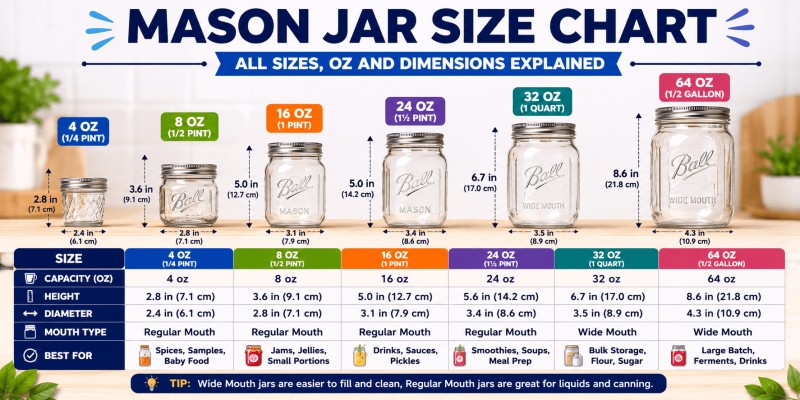
If you have ever stood in a store staring at a shelf full of mason jars and had no idea which one to pick, you are not alone. Mason jars come in so many sizes that choosing the right one without a proper guide can feel overwhelming. The good news is that once you understand the size chart and what each measurement actually means in real life, the decision becomes straightforward. This guide covers the complete mason jar size chart with all standard sizes, their exact dimensions in inches and centimeters, fluid ounce and milliliter measurements, and the best uses for each size. Whether you are canning food at home, packaging a product for your business, or just organizing your pantry, this chart has everything you need in one place.
What Does "Mason Jar Size" Actually Mean?
Mason jar sizes are always measured in fluid ounces (fl oz), which refers to how much volume a jar can hold, not how much it weighs. So when a jar says "16 oz," it means it can hold 16 fluid ounces of liquid, which equals 2 cups or about 473 ml.
The physical size, meaning the height and diameter, can vary slightly between brands like Ball, Kerr, and others. However, the volume capacity for each named size remains consistent across all standard mason jar manufacturers.
Two lid-opening types affect usability:
- Regular Mouth: opening diameter of approximately 2.75 inches, best for pourable liquids and sauces
- Wide Mouth: opening diameter of approximately 3.38 inches, best for chunky foods, easy filling, and cleaning
Both mouth types are available across most sizes in the chart below.
Complete Mason Jar Size Chart: All Sizes with Dimensions
| Size Name | Fluid Oz | Cups | Milliliters | Height (inches) | Diameter (inches) | Best Use |
|---|---|---|---|---|---|---|
| Mini / Sample | 4 oz | ½ cup | 120 ml | 2.5 in | 2.5 in | Spices, samples, gifts |
| Half Pint | 8 oz | 1 cup | 240 ml | 3.8 in | 3.0 in | Jams, candles, and sauces |
| ¾ Pint | 12 oz | 1.5 cups | 355 ml | 4.5 in | 3.0 in | Drinks, layered snacks |
| Pint | 16 oz | 2 cups | 473 ml | 4.8 in | 3.2 in | Everyday kitchen use |
| Pint & Half | 24 oz | 3 cups | 710 ml | 6.5 in | 3.5 in | Smoothies, dry goods |
| Quart | 32 oz | 4 cups | 946 ml | 6.9 in | 3.9 in | Pickling, bulk storage |
| Half Gallon | 64 oz | 8 cups | 1,893 ml | 9.5 in | 4.5 in | Fermentation, large batches |
| Gallon | 128 oz | 16 cups | 3,785 ml | 13.0 in | 6.0 in | Commercial bulk storage |
Note: Height and diameter measurements are approximate averages. Slight variations may exist between brands.
Each Mason Jar Size Explained in Detail
4 oz Mason Jar Mini / Sample Size
Dimensions: Approximately 2.5 inches tall, 2.5 inches in diameter
The 4-oz mason jar is the smallest size in the standard lineup. It fits easily in the palm of your hand and holds just half a cup of content. Because of its tiny size, it is rarely used for bulk storage. Instead, it is most valued for presentation and gifting purposes.
Best uses: Individual spice portions, honey samples, lip balm, body scrubs, baby food portions, wedding favor gifts, and single-serve condiments. Small businesses selling artisan skincare or food products often use this size for sampler sets.
8 oz Mason Jar Half Pint
Dimensions: Approximately 3.8 inches tall, 3 inches in diameter
The 8 oz half-pint jar is one of the best-selling mason jar sizes for both home kitchens and small businesses. It holds exactly one cup of content and is light enough for easy daily use. It is available in both regular and wide-mouth styles.
Best uses: homemade jams, jellies, fruit preserves, hot sauce, salad dressings, soy candles, overnight oats, and dessert cups. For product packaging, this size offers a premium look without excessive material cost and photographs well for online listings.
12 oz Mason Jar Three-Quarter Pint
Dimensions: Approximately 4.5 inches tall, 3 inches in diameter
The 12-oz size sits between the half-pint and pint, making it a less common but increasingly popular option. Its tall, slender shape makes it visually appealing and practical for beverages.
Best uses: iced drinks with straws, layered yogurt parfaits, dessert-in-a-jar gifts, granola storage, and snack portions. This size works especially well for cafes and food businesses that want to serve drinks in mason jars with a branded lid.
16 oz Mason Jar Pint (The Standard)
Dimensions: Approximately 4.8 inches tall, 3.2 inches in diameter
The 16-oz pint jar is the most widely recognized mason jar size. It is considered the standard by most home canners and packaging suppliers. If you were to buy a mason jar without thinking about it, the pint size is likely what you would grab.
Best uses: Canning tomatoes, salsa, and pickles; storing leftover soups and sauces; packing grain bowls and salads for lunch; fermenting small batches of yogurt or kombucha; and serving beverages in cafes. For product packaging businesses, this is the highest-demand size for food-grade jar orders.
24 oz Mason Jar Pint and a Half
Dimensions: Approximately 6.5 inches tall, 3.5 inches in diameter
The 24-oz mason jar is not as widely produced as other sizes but fills a practical gap between the standard pint and the quart. It is almost always sold in a wide-mouth style, which makes it easy to fill and clean. Its extra height makes it well-suited for tall ingredients and large portions.
Best uses: Smoothie and protein shake storage, dry pantry ingredients like granola or nuts, pasta, dried beans, and flour. Meal-prep enthusiasts frequently use this size for weekly food prep containers.
32 oz Mason Jar Quart
Dimensions: Approximately 6.9 inches tall, 3.9 inches in diameter
The 32 oz quart jar is the standard choice for serious home canners and food preservation enthusiasts. It holds 4 cups of content and offers a sturdy, reliable build for long-term storage. Both regular and wide-mouth styles are widely available in this size.
Best uses: pickling cucumbers, beets, and carrots; storing homemade broth and stock; fermenting vegetables like sauerkraut, kimchi, and pickles; and bulk pantry organization for grains, lentils, and dried fruit. Zero-waste households commonly use quart jars as their primary kitchen storage solution.
64 oz Mason Jar Half Gallon
Dimensions: Approximately 9.5 inches tall, 4.5 inches in diameter
The 64-oz half-gallon jar is designed for large-scale storage. At nearly 10 inches tall and holding 8 cups, it requires two hands to lift when full and is best kept stationary in a pantry, on a shelf, or on a countertop.
Best uses: large-batch kombucha or kefir fermentation, cold brew coffee, sun tea, bulk grain and nut storage, and home brewing projects. Restaurants and cafes also use these jars for water infusions and cold beverage displays.
128 oz Mason Jar Full Gallon
Dimensions: Approximately 13 inches tall, 6 inches in diameter
The gallon mason jar is the largest standard size available. It is a heavy-duty jar meant for commercial use or very large-scale home projects. When full, it is too heavy to carry comfortably with one hand.
Best uses: Commercial food preparation and ingredient storage, large-scale fermentation projects, decorative display pieces at markets and events, and storing a full gallon of drinking water or juice.
Regular Mouth vs Wide Mouth Size Availability Comparison
| Size | Regular Mouth | Wide Mouth |
|---|---|---|
| 4 oz | Available | Available |
| 8 oz | Available | Available |
| 12 oz | Available | Available |
| 16 oz | Available | Available |
| 24 oz | Rare | Available |
| 32 oz | Available | Available |
| 64 oz | Rare | Available |
| 128 oz | Not standard | Available |
For sizes 24 oz and above, wide-mouth jars are strongly recommended. The wider opening makes filling, cleaning, and accessing the contents significantly easier, especially for solid or chunky foods.
How to Use This Size Chart for Product Packaging
If you are a business owner sourcing mason jars for product packaging, the size chart above is your starting point, but there are a few additional considerations:
Match size to product density: A thick cream or scrub does not pour like water. Use wide-mouth jars for any product that needs to be scooped out.
Think about shelf presence: Taller jars like the 24 oz and 32 oz have a strong visual impact on retail shelves. Smaller jars like the 4 oz and 8 oz feel premium and boutique.
Consider shipping weight: larger jars filled with product add significant weight per unit. Factor jar weight into your shipping cost calculations before deciding on bulk quantities.
Label space matters: Jars with a flat or slightly tapered body give you more usable label surface area. The 16 oz and 32 oz sizes offer the best balance of height and diameter for custom labels.
At Custom Boxes Zone, we supply mason jars across all standard sizes with options for custom labeling, branded lids, and retail-ready packaging to help your product stand out on any shelf.
Quick Reference: Mason Jar Size Names Decoded
People often use traditional names alongside the ounce measurements, which can confuse. Here is what each name means:
- Mini or Sample = 4 oz
- Half Pint = 8 oz
- Three-Quarter Pint = 12 oz
- Pint = 16 oz
- Pint and a Half = 24 oz
- Quart = 32 oz
- Half Gallon = 64 oz
- Gallon = 128 oz
Final Thoughts
The mason jar size chart is not complicated once you see it laid out clearly. Each size has a specific volume, a set of real-world dimensions, and a purpose it is best suited for. Choosing the right size comes down to knowing what you need to store, how much of it, and whether you need easy access to the contents. If you are sourcing jars for personal use, the 16-oz pint is the best all-around starting point. If you are building a product line, start with the 8 oz and 16 oz sizes and expand based on customer demand. And if large-scale storage or fermentation is your goal, the 32-oz and 64-oz jars will serve you best.