






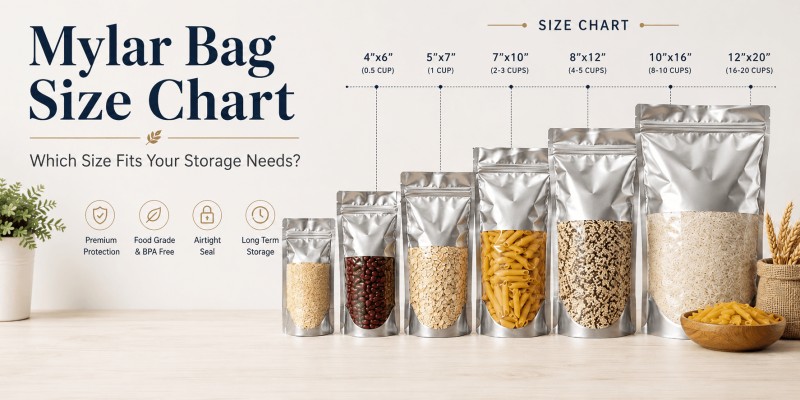
A mylar bag size chart matches bag dimensions to product weight, fill volume, and required shelf life, running from 3″×4″ sample pouches up to 20″×30″ bulk bags. The right size depends on ounces or grams, gallons or quarts, and mil thickness for oxygen-barrier strength. Getting it wrong wastes material or leaves headspace for spoilage. CustomBoxesZone builds standard and custom mylar bags to your exact product specs.
- 1 oz retail → 6″×9″
- 1 gallon / 1 lb rice → 10″×14″
- 5 lb bulk → 14″×20″
- 5 gallon / long-term → 20″×30″
- Shelf life → 4-mil for 1–5 years, 7-mil for 15–25 years
What Is a Mylar Bag Made Of and Why Do Sizes Matter So Much?
A mylar bag is a flexible, foil-laminated pouch built from layers of polyester (PET), aluminum foil, and food-grade polyethylene (PE). Those layers create a near-total barrier against oxygen, light, moisture, and odor, which is exactly why mylar is the standard for long-term food storage, cannabis, coffee, and pharmaceutical packaging. But that barrier only performs when the bag is correctly sized to the product inside.
Why Mylar Bag Size Is the First Decision You Make
Picking a mylar bag size looks simple until the product is sitting on the scale and none of the standard options seem to fit right. Too small, and the seal sits under strain with no headspace for an oxygen absorber. Too large, and the bag traps excess air that speeds up oxidation and wastes shelf space in storage. Size is not a cosmetic choice for mylar packaging the way it might be for a printed box. It directly determines how much oxygen and moisture reach the product, how long an oxygen absorber stays effective, and how well the bag survives stacking, shipping, or years in a basement or warehouse.
How to Read a Mylar Bag Size Chart
Mylar bags are typically labeled three different ways, and mixing them up is the most common sizing mistake. The first is by outer dimension, in inches, measuring the sealed bag from edge to edge — this number includes the seal margin, so usable interior space is always slightly smaller than the stated size. The second is by weight capacity, in grams or ounces, which works well for retail-style products like herbs, coffee, or pre-portioned snacks. The third is by fill volume, in quarts or gallons, which is the standard used for bulk dry goods like rice, beans or flour.
Mylar Bag Size Chart by Weight, Volume and Dimension
The mylar bag dimensions below reflect what is widely used across manufacturers. Exact interior capacity varies slightly by gusset depth, seal width, and film thickness always confirm against the specific bag before finalizing packaging for a production run.
| Bag Size (in) | Weight Capacity | Fill Volume | Oxygen Absorber | Best For |
|---|---|---|---|---|
| 3″ × 4″ | ~1 gram | — | 50–100cc | Single-dose samples, small parts |
| 3.5″ × 5″ | ~3.5 g (⅛ oz) | — | 100cc | Loose herbs, tea, spice samples |
| 4″ × 6″ | ~7 g (¼ oz) | — | 100cc | Herbs, small retail portions |
| 5″ × 8″ | ~14 g (½ oz) | — | 100–200cc | Granular retail product |
| 6″ × 9″ | ~28 g (1 oz) | — | 200cc | Full ounce, loose or granular |
| 8″ × 12″ | ~1 lb (dense) | ¼ gallon (1 quart) | 300cc | Rice, beans, small-batch retail |
| 10″ × 14″ | ~1 lb rice | 1 gallon | 300cc | Household food storage benchmark |
| 14″ × 20″ | ~5 lb | ~2.5 gallon | 2000cc | Bulk dry goods |
| 16″ × 20″ – 18″ × 24″ | ~8–20 lb | 2–5 gallon | 2000–2500cc | Family emergency food storage |
| 20″ × 30″ – 24″ × 36″ | 20 lb+ | 5–6 gallon | 2500cc+ | Bulk/wholesale, bucket liners |
Small Retail and Sample Sizes
A 3″×4″ bag is the smallest common format, holding roughly one gram of product, and is typically used for single-dose samples or jewelry-style small parts. Moving up, a 3.5″×5″ bag holds about an eighth of an ounce, or 3.5 grams, which is the standard format for loose herbs, tea, and spice samples. A 4″×6″ bag steps up to roughly a quarter ounce, or seven grams, giving enough room for the product to sit without crushing against the seal. A 5″×8″ bag holds about a half ounce, or 14 grams, and a 6″×9″ bag is the common choice for a full ounce of loose or granular product. For samples, single servings, and promotional runs, smaller mylar pouches deliver the same food-grade barrier protection in a compact, resealable format.
Mid-Range and Household Storage Sizes
Once product volume moves past a few ounces, sizing shifts from weight-based labeling to fill volume. An 8″×12″ bag is commonly treated as a quarter-gallon (one-quart) size, suited to about a pound of denser dry goods such as rice or beans. A 10″×14″ bag is the industry benchmark for a one-gallon fill, widely used for a single pound of rice with room left for a standard 300cc oxygen absorber and proper heat-seal headspace. These two sizes cover most household food storage and small-batch retail packaging needs.
Bulk and Long-Term Storage Sizes
For larger quantities, a 14″×20″ bag typically holds around five pounds of rice or similar dry goods and pairs with a larger 2000cc oxygen absorber. Bags in the 16″×20″ to 18″×24″ range move into the two-to-five-gallon category, holding roughly eight to twenty pounds of product, and are common for family-scale emergency food storage. At the top end, bags from 20″×30″ up to 24″×36″ and larger are built for bulk or wholesale fills, often used as five-gallon bucket liners rather than as standalone packaging.
What Size Mylar Bag Do I Need for Rice and Dry Food?
For one pound of rice, a 10″×14″ one-gallon bag is the standard choice, leaving room for a 300cc oxygen absorber and a clean seal. For five pounds of rice, step up to a 14″×20″ bag with a 2000cc absorber. For bulk rice or wheat storage inside a five-gallon bucket, use a 20″×30″ bag as a liner. Because rice, beans, and flour are dense, they follow weight-based sizing closely unlike airy products, which need extra room. As a rule for long-term food storage, pair a 7-mil bag with the correct absorber and store away from heat and light for maximum shelf life.
Mylar Bag Thickness The Second Half of the Sizing Decision
Size determines how much product fits, but thickness, measured in mils, where one mil equals 25.4 microns, determines how well the bag protects it once filled. A 3-mil bag suits short-term retail and single-use packaging. A 4-mil bag has an oxygen transmission rate low enough for one to five years of dry storage under normal conditions, which covers most kitchen and retail use cases. A 5-mil bag is a common middle ground for resealable retail pouches. A 7-mil bag drops the oxygen transmission rate roughly fifty times lower, supporting fifteen to twenty-five years of storage, and adds more puncture resistance for rough handling or long-term storage meaningfully. For heavy-duty, smell-proof, or airtight retail use, a vacuum seal mylar bag pushes barrier performance further still.
Thickness rarely changes the interior volume of a given bag size in any way that matters for planning, but it does change how much headspace to leave. Thicker film holds its shape and seals more rigidly, so slightly less headspace is needed compared to a thinner, more flexible 3-mil bag, which needs extra room to fold and seal cleanly without stressing the seam.
Bag Styles Flat, Stand-Up, Gusseted and Resealable
Mylar bag dimensions aren't the whole story the bag style changes how a given size behaves on a shelf and in the hand. Flat pouches are the most space-efficient for samples and mailers. Stand-up (gusseted) pouches add a bottom or side gusset so the bag stands upright and holds more volume for its footprint, which is why retail food and coffee brands favor them. Resealable ziplock closures let customers reseal between uses, extending freshness and adding perceived value essential for coffee, snacks, and cannabis. A custom gusseted mylar bag combines the shelf presence of a box with the barrier of mylar, and can be sized from a few ounces up to several pounds.
How to Calculate the Right Mylar Bag Size for Your Product
Start by weighing the actual product rather than relying on a generic size chart alone, since density varies enormously between items. A cup of uncooked rice weighs around 6.5 ounces, while a cup of granulated sugar weighs closer to 7.1 ounces a small difference, but one that compounds across a five-pound fill. For loose, irregular, or aerated products like popcorn, freeze-dried fruit, or jerky, add roughly twenty to thirty percent more volume capacity than a straight weight-based chart would suggest, since these products do not pack down the way fine powders or dense grains do.
Once the target weight and rough volume are known, choose a bag size one increment larger than what feels exact. Every mylar bag needs one to two inches of headspace above the fill line to allow a clean, structurally sound heat seal, and any oxygen absorber added to the bag also needs room to sit against the product without pressing on the seal. As a general rule of thumb, plan for roughly 300cc of oxygen absorber capacity per gallon of bag volume, adjusting upward for higher-moisture products.
Matching Bag Size to Common Storage Categories
Spices, loose-leaf tea, and dried herbs almost always fall into the 3″×5″ to 4″×6″ range, where the priority is a tight seal around a small quantity rather than maximizing volume. Roasted coffee is a common exception to weight-based sizing, since whole or coarsely ground beans take up noticeably more room than an equivalent weight of a denser product, often pushing a one-ounce coffee sample into a bag sized for a heavier retail product.
Cannabis and CBD mylar bags typically use the 3.5-gram, 7-gram, and one-ounce formats as the retail standard, and these smell-proof, child-resistant categories carry additional labeling requirements that should be confirmed against current state regulations before finalizing bag specifications. Cosmetic and personal-care fills, such as a 16.9-ounce lotion pouch, tend to land closer to a half-gallon stand-up bag that holds its shape upright on a shelf. Bulk grains, legumes, and emergency food storage scale up through the one-gallon, two-gallon, and five-gallon formats, with thickness becoming as important as size once the storage horizon stretches past five years. For a natural, retail-ready look in these categories, a kraft mylar bag pairs the barrier with a branded exterior.
Custom Mylar Bag Sizes vs Standard Sizes
Custom dimensions also make sense for irregular product shapes, brand-specific gusset or window requirements, or wholesale mylar bags where even a small per-unit saving compounds significantly across volume. CustomBoxesZone builds mylar bags to exact interior dimensions rather than rounding up to the nearest standard size, which matters most for cannabis, CBD, coffee, and cosmetic brands running consistent SKU volumes rather than one-off orders.
Common Mylar Bag Sizing Mistakes to Avoid
Finally, treating every bag in a product line as one universal size, rather than sizing each SKU individually, is where custom sizing usually pays for itself fastest.
Ready to get your mylar bags sized right the first time? CustomBoxesZone builds standard and fully custom printed mylar bags food-grade, smell-proof, and resealable to your exact product specs, with free design and free shipping. Request a free quote today.