






The ideal shipping box size is not only about fitting a product. Size of the box impacts product protection, material consumption, warehouse space, dimensional weight, shipping costs, and the customer’s unboxing experience. A box that is too big adds void fill and carrier costs, while a box that is too tight does not allow for enough protective cushioning.
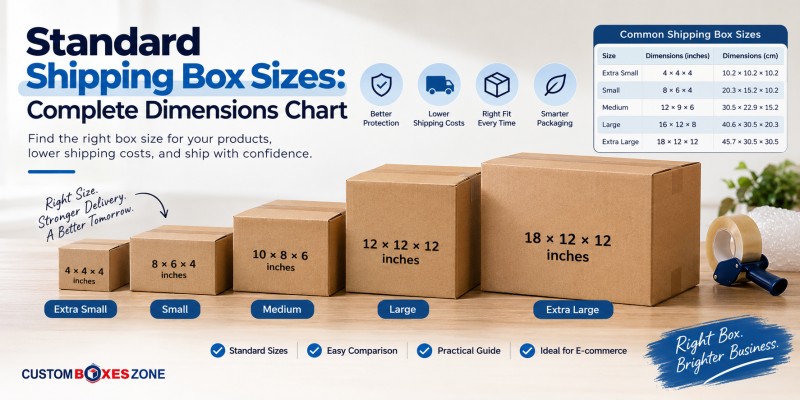
The first thing to know if you’re looking for conventional shipping box sizes is that there isn't one size that fits all set of measurements utilized by all packaging suppliers or carriers. Instead, companies employ a number of standard corrugated box sizes that match the types of products commonly transported. Popular sizes are 8 x 6 x 4 inches, 10 x 8 x 6 inches, 12 x 9 x 6 inches, 12 x 12 x 12 inches, 16 x 12 x 8 inches and 18 x 12 x 12 inches.
This tutorial includes a helpful shipping box size chart, information on how box dimensions are calculated, examples of how size impacts dimensional weight, and tips for selecting a box that protects your product while avoiding paying to ship empty space.
Standard Shipping Box Sizes Overview
Below is a list of common shipping box sizes used by e-commerce companies, retailers, warehouses, subscription brands and other enterprises. Many of these measurements are replicated on current packaging-industry charts, although specific stocked sizes vary from supplier to supplier.
| Size Category | Dimensions (L x W x H) | Dimensions in CM | Approx. Uses |
|---|---|---|---|
| Extra Small | 4 x 4 x 4 in | 10.2 x 10.2 x 10.2 cm | Jewelry, samples, small accessories |
| Small Flat | 6 x 4 x 4 in | 15.2 x 10.2 x 10.2 cm | Small cosmetics, parts |
| Small Cube | 6 in x 6 in x 6 in | 15.2 cm x 15.2 cm x 15.2 cm | Candles, Mugs, Small Gifts |
| Small Rectangular | 8 × 6 × 4 in | 20.3 × 15.2 × 10.2 cm | Skin care, books, phone accessories |
| Small Cube | 8 × 8 × 8 in | 20.3 × 20.3 × 20.3 cm | Glassware, packaged items |
| Medium | 10 × 8 × 6 in | 25.4 × 20.3 × 15.2 cm | Clothing, books, small gadgets |
| Medium Cube | 10 in x 10 in x 10 in | 25.4 cm x 25.4 cm x 25.4 cm | Kitchen products, gift packages |
| Medium Rectangular | 12 × 9 × 6 in | 30.5 × 22.9 × 15.2 cm | Shoes, books, e-commerce orders |
| Medium | 12 × 10 × 8 in | 30.5 × 25.4 × 20.3 cm | General merchandise, different products |
| Medium Cube | 12 x 12 x 12 in | 30.5 x 30.5 x 30.5 cm | Toys, Home Goods, Fragile Items |
| Medium-Large | 14 × 10 × 8 in | 35.6 × 25.4 × 20.3 cm | Bundles, larger retail products |
| Large Rectangular | 16" x 12" x 8" | 40.6 x 30.5 x 20.3 cm | Electronics, apparel, board games |
| Large | 18 x 12 × 12 in | 45.7 × 30.5 × 30.5cm | Appliances, kitchenware, multi-item orders |
| Extra Large | 20 × 16 × 12 in | 50.8 × 40.6 × 30.5 cm | Home decor, bigger products |
| Oversize Reference | 24" x 18" × 18" | 61 × 45.7 × 45.7 cm | Bulk products, bedding, wholesale shipping |
Use these figures as the real-world examples, not the absolute measure for the industry.
What is the meaning of standard shipping box size?
The phrase standard shipping box sizes can sound as if every manufacturer is working off the same official list. In practice, package vendors normally provide sizes that are in demand from businesses but there is no one size that is a must-have for a small, medium, or large shipping box.
For buyers, the more pertinent question is:
What size standard shipping box will adequately protect my product with the least amount of wasted space?
Your final size will depend on product dimensions, protective material, quantity of items per shipment, box strength, carrier rules and fulfillment needs.
A shipping box dimensions table is therefore a starting point, not a replacement for verifying the actual packed product.
How are shipping box dimensions calculated?
The box dimensions are usually expressed in this order:
Length × Width × Height (L × W × H)
For example, 12 × 9 × 6 inches means the box measures 12 inches long, 9 inches wide and 6 inches high.
In packaging specifications, the dimensions are commonly described as the available interior space. But if a carrier requests measurements of a package, measure the finished outside dimensions after the box is built, filled and closed.
This makes a difference.
Corrugated board has thickness, and the outside of a finished carton may be larger than its stated inner dimensions. Tape, inserts or protective materials may also affect finished proportions, bulging out.
FedEx’s current measuring guidance expressly states that the printed dimensions on retail boxes can be inside dimensions and the completed cargo must be measured on the outside.
A practical procedure is:
-
Measure the product.
-
Determine the cushioning or inserts required.
-
Choose a box based on its internal dimensions.
-
Shut the box and pack it.
-
Measure the ultimate external length, width and height for shipping.
For carrier purposes, the longest outside side is normally considered the length. UPS and USPS both consider the length to be the largest dimension when calculating package measurements.
Box Inside Dimensions vs External Dimensions
Internal measurements give you the useful space the box provides.
External dimensions tell the transporter how much actual space the finished product takes up.
When picking packaging for your goods, use interior dimensions.
For postage calculation, dimensional weight, length plus girth, or carrier size eligibility, use the outside dimensions.
The difference becomes particularly critical if a business is using a heavier corrugated material or if a package is close to a dimensional-weight or carrier-size break point.
Why is the right size shipping box important?
Delivery Cost
Dimensional weight is used by major carriers and takes into account the actual weight of a package plus its volume.
The weight of a light-weight item packaged in a large container may then cost more to ship than would be expected.
FedEx states that dimensional weight is a measure of the space a box takes up. The carrier may charge for shipment based on the dimensional weight or the actual weight, whichever is larger.
Warranty on Product
There is too much vacant space and products will shift unless properly cushioned.
Another difficulty is caused by too little room. If there is not enough room for protective material, fragile objects can be positioned near the box walls and experience additional force during drops and handling.
The optimal shipping box size is one that provides enough room for the protection the goods really requires, without having a big empty hole around it.
Packing Material
Oversized boxes tend to have more corrugated board, tape, and void fill.
A better-fitting box can reduce the amount of needless packaging material while still providing the protection needed for transit.
Average Small, Medium & Large Box Dimensions
Small Shipping Boxes
Some typical sizes of small shipment boxes are:
- 4 x 4 x 4 inches
- 6 x 4 x 4 inches
- 6 x 6 x 6 in
- 8 x 6 x 4 inches
- 8 x 8 x 8 inches
These sizes are commonly used for items like jewelry, cosmetics, candles, cups, accessories, samples and miniature gadgets.
The tightest shipping box isn’t necessarily the safest pick.
For example, a glass candle may need space for protective paper, padding or a fitted insert. You may not need as much more space for a sturdy product already secured in strong retail packaging.
Think of the full bundled product, not just the item alone.
Shipping Boxes, Medium
Average medium shipping box sizes are:
-
10 x 8 x 6 inches
-
10” x 10” x 10"
-
12 x 9 x 6 inches
-
12 x 10 x 8 inches
-
12 x 12 x 12 inches
-
14 x 10 x 8 inches
-
16" x 12" x 8"
These dimensions cover a broad range of everyday e-commerce shipments including shoes, books, apparel, toys, gift packages, subscription products, kitchen items, cosmetics and gadgets.
A business shouldn’t just grab the biggest medium box and ship every order in it. If you tend to ship smaller items, utilizing an enormous box frequently can mean more packaging material waste and a larger delivery volume.
Large & Extra Large Shipping Boxes
Common large shipping box measurements are:
-
18 x 12 x 12 inches.
-
12 by 16 by 20 inches.
-
24 x 18 x 18 inches
They can work for home items, small appliances, mattresses, larger commodities, bundle products and wholesale shipments.
Bigger boxes need more attention to vacant space and to the strength of material.
Maintaining one extremely large “universal” box may make purchasing easier, but if most of the product is only in part of the carton, the business is often paying for extraneous corrugated, filler, storage space, and shipment volume.
For large, lightweight products, custom dimensions might be very valuable since decreasing the wasted space immediately reduces the volume of the packaging.
What Is Dimensional Weight?
Dimensional weight is a pricing technique which uses the amount of space a product takes up rather than just its scale weight. Dimensional weight is often termed DIM weight.
FedEx now releases the following dimensional-weight formula for U.S. shipments:
Length x Width x Height / 139
measured in inches.
Example: 12 x 12 x 12 inch shipping box
12 x 12 × 12 = 1,728 cu in
1,728 ÷ 139 = 12.4 lbs
Example: 10 × 8 × 6 inches box
10 x 8 x 6 = 480 cubic inches
480 ÷ 139 = about. 3.5 lbs
While the contents of the two packages may weigh exactly the same on the scale, they take up transit space considerably differently.
This is where cutting down on extra package volume could potentially cut delivery costs.
USPS Ground Advantage also now employs a divisor of 139 for dimensional-weight restrictions applicable to packages bigger than one cubic foot.
Carrier restrictions and prices can change, so always check the current carrier rate guide when determining final shipping charges.
Box Volume: Another Important Number
Calculating shipping box volume is rather simple:
Length x Width x Height equals Cubic Feet
For example:
A 12×12×12 shipping box contains:
12 * 12 * 12 = 1728 cubic inches
A shipment box of 16 × 12 × 8 contains:
16 x 12 x 8 = 1536 cubic inches
This is a crucial point that the comparison makes:
A longer box isn’t necessarily a bigger box overall.
Design matters.
If your product is wide and somewhat flat, then a rectangle box can take up less cubic area than a deep cube.
If the goods is roughly the same length, breadth, and height, a cube-shaped shipping box may be a better option.
Comparing total box volume can assist firms analyze packaging efficiency, warehouse storage, pallet utilization, void-fill usage and dimensional weight.
Choosing the Best Size Shipping Box
1. Evaluate Your Product
Start with precise measurements of the item.
Measure the longest, broadest & tallest points.
If the item is already retail-packaged, measure the retail package, not the naked item. The retail package must be able to fit in the shipping carton.
Place a number of products in the location they will be used in fulfillment and measure the full set.
2. Determine How Much Protection You Need
A folded T-shirt and a ceramic mug don't require as much protection.
Fragile products may need bubble cushioning, paper, molded pulp, corrugated inserts, foam, dividers or other protection system.
Items that are durable may need a lot less clearance.
Don’t automatically add a certain amount of inches to every product. Figure out how much room the specific product will take up.
3. Allow room for padding or inserts
Understand your protective packaging system. Add the appropriate clearance to the product measurements.
State the dimensions of your product:
8x6x4 inch
An 8 x 6 x 4 shipping box would leave very little room for packing stuff.
If you need cushioning, though, a 10 x 8 x 6 inch box could be a better choice.
But still it has to be checked with the real goods for the final size.
4. Comparison of Stock Shipping Box Sizes
Then compare the sizes of readily accessible boxes to the needed packed dimensions.
If a stock container is almost what you need, it may be the easiest and most cheap choice.
But if the closest conventional size leaves a few inches of wasted space, look into custom packing.
5. Think about Custom Shipping Boxes
The more you send the same product or combination of products again and again, the more your firm benefits from custom sizing.
The box can be built around the product rather than forcing your goods into whatever stock carton is available.
This can assist decrease unnecessary space, packing filler, material consumption and dimension volume.
6. Bring a Real Sample
Don’t sign off on packaging from just measurements in a spreadsheet.
-
Put the box together.
-
Put in the real stuff.
-
Add the real cushion or filler.
-
Close and seal the carton as it will be transported.
-
Verify whether the item moves, hits the walls, gets crushed, or has too much vacant space.
For fragile or important products, appropriate transportation testing can give you further confidence.
7. Measure the Completed Parcel
Pack and shut the box. Measure the exterior dimensions again.
Use these finished external dimensions to calculate carrier shipping expenses.
Recommended Shipping Box Sizes for Product
| Product | Average Starting Size | Primary Consideration |
|---|---|---|
| Jewelry | 4x4x4 or 6x4x4 | Retail box & presentation |
| Cosmetics | 6 × 4 × 4 or 8 × 6 × 4 | Inserts, leaks, several item sets |
| Candles | 6 x 6 × 6 or 8 × 8 × 8 | Glass protection and cushion |
| Books | 8 x 6 x 4 or 10 x 8 x 6 | Protection of weight and corners |
| Apparel | 10 × 8 × 6 or 12 × 9 × 6 | Size and quantity, folded |
| Shoes | 12 x 9 x 6 or larger | Existing Dimensions of Shoe Box |
| Subscription Kits | 10 x 8 x 6 or 12 x 10 x 8 | Product mix and presentation |
| Small Electronics | 8 × 6 × 4 or 10 × 8 × 6 | Accessories and protective inserts |
| Kitchenware | 12 x 12 x 12 or 18 x 12 x 12 | Weight, divisions, fragility |
| Home Decor | 16x12x8 or greater | Shape & dimensional weight |
These dimensions should be considered as guidelines. The ultimate packaging size will be based on your real product dimensions, weight, fragility and cushioning requirements.
Box Size Is Part of the Packaging Decision
Correct dimensions do not necessarily mean sufficient strength.
Heavy or fragile shipments may require double-wall material, partitions, bespoke inserts, modified flute structure or stronger corrugated board.
A box for light clothes and a box of the same size for heavy hardware can take completely different materials.
Never forget to consider shipping box size, product weight, corrugated strength, inside protection and structural design at the same time.
USPS, UPS and FedEx Package Size Considerations
Carrier maximums are not the same as typical shipment box sizes.
UPS
UPS says that items in its small-package network normally can weigh up to 150 pounds, be up to 108 inches long and have a combined length and girth measurement up to 165 inches.
UPS calculates length + girth to mean the longest side plus two times the width plus two times the height.
FedEx Ground
FedEx Ground now takes shipments up to 150 pounds, with a maximum length of 108 inches and a combined length and girth of 165 inches.
USPS Ground Advantage
USPS regulations vary per mail class. Now USPS Ground Advantage can handle shipments up to 70 pounds and up to 130 inches combined length and girth.
These are maximum service limits, not suggested dimensions for daily shipping boxes.
Dimensional-weight pricing, nonstandard charges, big-package surcharges and other carrier rules can apply before a shipment hits the ultimate maximum.
Before sending out exceptionally large or heavy items, check with the carrier and particular shipping service.
Standard Boxes or Customized Shipping Boxes
Stock shipping boxes are great if you need your packaging right away, ship lesser quantities, are testing a new product, or have a lot of unconnected product sizes.
Custom Shipping Boxes are worth considering when:
-
You ship the same goods again and over.
-
Regular crates take far too much space.
-
Dimensional weight raises delivery expenses.
-
A regulated fit for a delicate product.
-
You need unique print or branded packaging.
-
You require bespoke inserts or divisions.
-
Employees utilize too much void fill.
-
You'd like to simplify your packaging inventory.
CustomBoxesZone allows businesses to create boxes tailored to their products instead of trying to fit things into stock sizes and styles that don't work. They may select alternative dimensions, materials, styles, printing options, and finishes.
How to Reduce Shipping Costs via Better Box Sizing
Right-sizing is not merely picking the tiniest box you can cram yourself into.
The idea is to get the smallest possible shipping box that will nevertheless reliably secure the contents.
Start with your biggest volume orders.
Record:
-
Packed dimension
-
Product weight
-
Chargeable weight
-
Quantity of filler used
-
Damage per second
-
Most popular product pairings
Try out different sizes and forms of shipment boxes.
For instance, a 12 x 9 x 6 rectangular box might be more efficient than a 12 x 12 x 12 cube when the goods is reasonably flat.
Sometimes a tailored insert will snugly hold an item, and the exterior box can be made smaller.
Not dramatic, but the most useful optimization. Removing unwanted cubic volume in a box that ships thousands of times can be more beneficial than redesigning a carton used once in a while.
Shipping Box Sizes: Common Errors
Box Dimensions as Product Dimensions
If your goods is 10 inches x 8 inches x 6 inches you may require a larger box if you need cushioning or inserts.
Measure the entire packing system at all times.
External Measurements Disregarded
Packaging suppliers may provide dimensions that refer to internal space.
Your shipping carrier requires the final outside dimensions of the packed package.
Using a Single Large Box for Everything
One carton for many products sounds simple, but the convenience can mean more filler, shipping volume and dimensional weight.
More Empty Space Means More Protection, We Guess
A bigger box isn't necessarily safer.
Proper cushioning, inserts, dividers and structural support are more helpful than surrounding the product with empty space that isn’t required.
Excluding Product Weight
Two products may have the same box dimensions but one may weigh considerably more and therefore require a different grade of corrugated.
Rules of Carrier Forgetting
Just because your box physically holds and protects your product doesn’t mean that carriers won’t see it as nonstandard or oversized.
Check shipping requirements before finalizing unusually large packaging.
Final Thoughts
Standard shipping box sizes provide businesses with useful reference points, but the ideal carton should ultimately be selected around the product rather than around a label such as “small,” “medium,” or “large.”
Measure the product accurately. Determine how much cushioning it requires. Compare common shipping box dimensions. Pack a real sample. Then measure the completed external parcel before calculating shipping charges.
The goal is simple:
Protect the contents while minimizing unnecessary space, material, and dimensional-weight exposure.
For many businesses, common sizes such as 8 × 6 × 4, 10 × 8 × 6, 12 × 9 × 6, 12 × 12 × 12, 16 × 12 × 8, and 18 × 12 × 12 inches can cover a substantial share of everyday shipments.
When those stock sizes create too much unused space, custom dimensions can provide a better solution.
CustomBoxesZone can produce custom corrugated and shipping boxes in dimensions built around your products, with options for custom printing, branding, materials, and finishing.
Instead of paying to package and ship unnecessary empty space, choose shipping box dimensions that make sense for your product, carrier, customer, and fulfillment process.